Horsemanship Pages
- *Home
- *Sitemap
- *SEARCH THE SITE
- *Horse History
- *Horseman Tips
- *Horsemanship
- *Amazing Horse Hoof
- *Horse Anatomy Pictures
- *Rope Halters
- My Random Horse Thoughts
- *Tying A Horse
- *Bosal/Hackamores
- *Bad Horsemanship
- *Misc Horse Info
- *Trailer Loading
- *Training Videos
- *Hobbles
- *Horse Articles
- *Health and Medical Info
- Horse & Rider Fear
- Opposition Reflex
- *Answers to Questions
- *Cowboy Wisdom
- *Cookie Recipe for Horses
- *Horse Jokes
- *Cowboy Weather
- *Sites and Links
- *A Horse"s Prayer*
- *Photos Rick and Horses
- *Clinics on Request*
- *Contact Rick
Think Like A Horse - The Horse"s Hoof
Rick Gore Horsemanship

Horses love it when their owners understand them.
Horsemanship is about the horse teaching you about yourself.
Horse Hoof Information:
The Amazing Horse Hoof
The hoof is simply amazing in that it does so much, is so important and without it the horse does not live. This is why the old saying "No Hoof - No Horse" has been around for years. Taking care of and understanding the hoof is paramount to good horsemanship and providing proper care for your horse. I am not a Farrier or a horse shoer, but I know the importance of taking care of a horse"s feet. I am putting this page together to help educate you on the hoof and the importance of proper hoof care.
The following article is reprinted from Dr. Strasser:
HARMFUL EFFECTS OF SHOEING (Abridged) by Dr. Hiltrud Strasser

Motivation:
A barefoot horse is capable of performing all the tasks that could be expected of a horse, without requiring any kind of protection of the hoof, PROVIDED that the hoof has not been weakened or deformed by the actions of man through unnatural treatment and living conditions.
When looking at literature dealing with hooves, the one constant reference is the damaging effect of shoes. For about 200 years, the ill effects of shoeing have been increasingly documented.
The textbook written by I.C. Gross, teacher of shoeing at the Royal Veterinary School of Stuttgart, clearly states in the preface that "the question of whether shoeing is the means by which to keep hooves sound, is to answered in the negative."
The fact that two of the main causes of the reduced life expectancy of domestic horses (in Europe, about 1/3 of the natural lifespan) are hoof and leg problems is disturbing and should be cause for research.
Scientific Publications:
That hooves are as hard and resistant to wear as the ground to which they become accustomed is ancient knowledge, already put into writing 2400 years ago by Xenophon, military leader of the Greek cavalry. The argument that "our trails are so rocky, the hooves wear down too much" is thus made invalid, since it is not the hoof, but the living conditions of the horse that cause the problem. Xenophon"s observations have been proved many thousands of times over; in more recent times (1986), Alexander and Colles once again reminded the riding and veterinary community of this truth with their article "Shoeing--an unnecessary evil" in the American Equine Veterinary Journal.
Bracy Clark, scientist at the London Veterinary College around 1800, found out that every shoe, no matter how correctly applied, inevitably forces the hoof to contract from year to year. He moreover lamented the fact that the books on equine anatomy portrayed these deformed, contracted hooves as sound hooves, since his veterinary colleagues obviously studied only the (sick) hooves of their patients, not sound hooves. This problem, unfortunately, is still largely present today: there is rarely a hoof shown in veterinary or farrier textbooks which is not a contracted hoof, yet described as a normal, sound foot.
DVM Zierold, under Professor Lungwitz in 1910, examined and compared the corium of shod and never shod horses, and found significant differences in structure, in that the corium of a shod horse is of a quality which makes the connection to the hoof capsule less stable (a factor in laminitis, for example).
Luca Bein, in his 1983 dissertation in Zurich, measured the shock absorption of barefoot, shod, and alternately shod horses. He concluded that a conventionally shod horse shows an absence of 60-80% of the hoof"s natural shock absorption. He demonstrated that "a shod foot on asphalt at a walk receives THREE TIMES the impact force as an unshod horse on asphalt at the trot." Bein also found that a shoe vibrates at about 800 Hz, damaging living tissue.
Dr. C.C. Pollit, at the University of Queensland, Australia, showed in his 1993 study of circulation in the hoof that a shod hoof is not supplied with blood in the normal fashion, but through an alternate route.
Professor Smedegards" publications make clear that shoeing prevents the hoof mechanism from working, if for no other reason that the horse is forced to walk unnaturally (the whole hoof impacts the ground at the same time, and the horse cannot break over naturally). A normal hoof contacts the ground first at the rear and side, then breaks over.
So from various sources throughout history, we can see it is known that;
1. shoeing causes the foot to become contracted (Clark)
2. shoeing causes a deviance of the normal laminae structure (Zierold)
3. the impact forces with each shod step are much greater, and the vibration of the shoe is damaging (Bein)
4. circulation is decreased through shoeing (Pollitt) 5. the side walls, at the widest part of the hoof, have to be able to move outward (Smedegard)
All these are veterinary professionals, though there are many other scientists who have added interesting dissertations to this topic.
Personal Observations:
"Hoof mechanism" is the term given to the movement of the hoof capsule. It has long been known and measured that, when weightbearing, the downward force of the skeleton on the front wall of the hoof capsule forces the coronet band, at its highest point, to sink downward and inward. This illustration is well known and accepted.
However, the downward-inward movement of the coronet band is possible only if the neighboring side walls can move outwards, or can sink into soft ground. This movement is coupled with the flattening of the concave sole, which makes room for the descending coffin bone.
This way, the solar corium is not bruised but rather is relaxed, and the capillaries in the sole and wall fill with blood. It is also known, and clearly illustratable (through infrared photography) that shod feet are cool, whereas unshod feet are warm.
This means that, at the widest part of the hoof (not only in the area of the heel), a considerable expansion of the hoof capsule takes place upon weightbearing. The wall expands NOT ONLY in the rearmost third of the hoof, as shown in many textbooks. Elementary pythagorean geometry supports this. For a normal warmblood, the concave sole must sink down about lcm, which necessitates an expansion of the wall of about lmm to each side. At higher speeds, the bulb of the heel contacts the ground first, which adds to the widening of the foot. Repeatedly, expansion of up to 4mm to each side have been found through live "prints" at the trot and canter.
A shod hoof is unable to expand as necessary, the concave sole cannot draw flat, and the solar corium is bruised as a result. When trimming such hooves, these bruises become visible.
To get back to L. Bein"s findings on shock absorption. The expansion of the hoof capsule complete with the flattening of the sole absorb up to 80% of the impact force. In terms of physics, this is conversion of of energy through reversible deformation.
The consequences of the lack of up to 80% of shock absorption are widely known as arthritis, tendonitis, etc. The damage done is all the greater when the horse is young, and the still-developing coffm bone is handicapped in its development to proper size through shoeing. Shoeing a horse under 3 (or even 2) years results in crippled and deformed coffin bones and steep, contracted hooves.
The negative effect of shoes on joints and tendons is increased through stresses during motion, ie. the weight of the shoe stressing the joint and tendon through centripedal force. The heavier the shoe, the greater this force.
The contracting effect of shoes increases from day to day, since the hoof grows continually, not straight down but in a conical shape. The hoof grows in width, but the shoe does not; after a month, the hoof grew by 1 cm, in length and width; with a shoe, only in length, forcing a constriction of the corium.
That a horse with such damage is still able to walk is due largely to the fact that the nerves have mostly become nonfunctional. As soon as the shoes are removed, circulation begins to return, and after a while the nerves "come back to life." So the damage will be present for years before the horse goes lame (due to inflammation, which brings circulation, and as such nerve activity).
The lack of circulation grows more severe with lack of movement. A shod horse which is worked all day tilling the field, for example, has better circulation than a shod horse standing in a box stall and ridden an hour a week.
With a reduction of circulation, metabolism at a cellular level is also adversely effected. Excess protein is not used in the building of tissue (ie. horn) but builds up in the organism (laminits, etc.)
The results of vibration have not yet been studied in horses. In human medicine, comparable effects exist in people working with vibrating tools such as saws, etc. Raynaud"s Syndrome, a condition showing alteration in blood vessels, is one of the problems associated with vibration. Laminitic horses show comparable alterations in their blood vessels, so vibration of shoes may be a factor in this.
Shoes change the way the horse"s foot meets the ground. On soft ground, into which they sink, they have a stronger than normal breaking action; on rock, asphalt and ice, they slip unnaturally. These unnatural actions have to be compensated for by muscles and ligaments, and can eventually lead to shoulder and hip problems. Logic would tell us that it is nonsensical to treat the symptoms without removing the cause.
A reduction of the damaging effects is found in horses whose hooves are regularly exposed to water, so that the horn can at least retain its elasticity. This explains to a great deal the seemingly problem-free, long period in which a horse may be ridden while shod: highly active lifestyle in a wet climate.
Today, many hooves are brittle and dried out to the point of having lost their natural elasticity, which by itself can lead to shock absorption and circulatory reduction.
There are no statistics about lasting damage from the kicks of shod horses; certain is that many people would be alive if the horse"s hoof which caught them in the head had not been shod.
Orthopedic shoes are heavier, more tightly attached, and the already damaging effects are magnified on an ill foot. Pressure on the frog or the sole causes a steepening of the coffin bone through the horse"s attempt to evade the painful pressure. The result is that the angle between coffm bone and middle phalanx decreases. The digital arteries are squeezed shut just outside the coffin bone. This gives a good deal of relief from pain, since the nerves are prevented from working, but healing is obviously not a consequence of this situation. This is especially true of the wedge pads.
A lesser, but still existent evil is the damaging effect of nails, vibrating inside the horn capsule.
EFFECTS OF "PROPER" SHOEING:
1. CONTRACTED HOOVES - the hoof meets the ground in a different way, since the horse is trying to evade the pain in the heel area, leads to muscle, tendon, and joint problems
2. BRUISING OF CORIUM - leads to lack of circulation, changes in metabolism leading to decreased horn formation and poor quality of horn, problems in the laminae, lack of sensation in the sole leading to tripping, etc., suspected problems in the metabolic rate of organs
3. INCREASED IMPACT FORCES - lead to bruising, tearing, strains with morphological changes in the corium, the hoof cartilage and joints, tendons, even hoof cancer
4. VIBRATION - leads to similar damages as in humans (vascular changes; Raynaud"s disease)
5. WEIGHT OF SHOES - puts strain on the joint capsules and leads to periostosis, arthritis, and increased damage on injury
6. CHANGE IN IMPACT - unnatural mechanics lead to muscle and tendon damage
7. NAIL HOLES - destroy the horn wall and decrease elasticity
8. METABOLISM DISRUPTIONS - lead to organic damage In every case, shoeing presents unnecessary harm to the horse--unnecessary, if the horse"s biological needs are met.
END of reprint These facts are hard to argue with, but I assure no one who makes a living putting on shoes will agree with any of this. You don"t ask your barber if you need a haircut and Don"t ask a Farrier if your horse needs shoes.
The picture below shows the natural flexing, movement and how blood flow occurs with a bare foot hoof. A shod hoof cannot move like this, cannot grow or develop strength. How can anyone not see the damage nails and steel shoes do to a hoof?
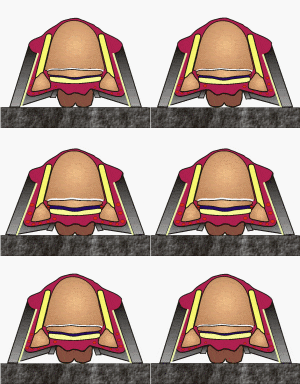
The picture above is a great example of the working hoof and how it supports weight and flexes as a horse walks and moves and how this action increases blood flow and keeps the hoof healthy. All of these actions helps provide the horse with padding and shock absorption for the hoof and legs. Which is why stalling (putting a horse in a stall) is very unhealthy for the horse and causes a lot of hoof and leg problems.
A healthy foot does not need shoes for protection
The hoof flexes naturally
Hoof grows normally
Blood flow is increased
Greater traction from the hoof expansion and flattening out
Better shock absorption
The digital cushion is allowed to assisting in shock absorption and blood flow
The frog gets pressure assisting in blood flow
Horseshoes restrict blood flow
Shoes numb the foot from lack of blood (this is why horses go lame when shoes are removed)
No hoof expansion with a shoe
Hoof flexing is prevented
Shoes on a hoof is like putting a clamp on a hose
Many forms of lameness are linked to shoes
Shoes change and affect the coffin bone and prevent the frog from functioning
A shod hoof loses 60 to 80% of the hoof"s natural shock absorption
Shoes cause three times the pounding force and pressure to the hoof
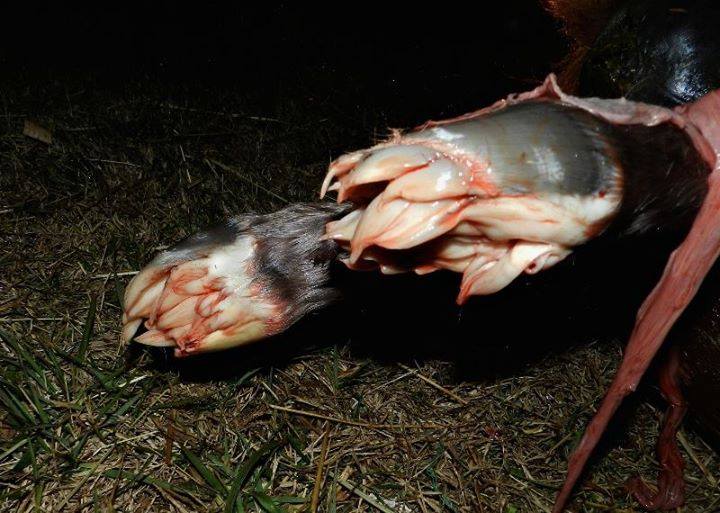
The picture below will take you to a Youtube video that shows an actual horse hoof that has been removed and shows the flexing and blood flow of the hoof. **Graphic Images** The video is excellent to show what happens every time a horse takes a step. This also shows how a horse shoe stops this flexing action, prevents blood flow and does the hoof harm; yet people are still stuck on putting shoes on horses. Although the video is not in English, it is worth watching.
Here Is Link To the Video Click Here to Watch
My Horse Anatomy Page has many more photos of the hoof so go there for more photos.
Proof Positive Why Shoes Are Bad for Horses:
In the picture below you see a thermograph photo of a horse, which shows blood flow, heat and circulation of the legs and hooves. YOU guess what foot has a shoe and which three do not have shoes? The photo is linked to a web page with the following quote: "The single most convincing thing for me was to see a thermograph of a horse"s feet--three of which were without shoes and one which was shod. Note the shod foot has virtually no blood circulation. I will NEVER put shoes on my horse again."
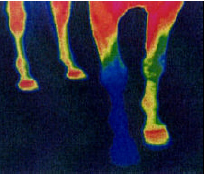
NOTE: In 1983, Luca Bein, did a dissertation on the shock absorption of a barefoot hoof compared to a shod hoof. His finding were that a conventionally shod hoof loses 60 to 80% of the hoof"s natural shock absorption. Bein also demonstrated that a shod hoof on asphalt, at a walk, receives THREE TIMES (3X) the impact force as as a barefoot hoof on asphalt at the trot. Bein found a shoe on a hoof vibrates at about 800 Hertz (Hz), which at that level does damage to living tissue. Think about that, a metal shoe that is nailed into a healthy hoof compromises the hoof wall, triples the impact force of every step, prevents blood flow, damages living tissue, prevents expansion of the hoof, restricts the natural flexing of the hoof, prevents normal growth of the hoof and yet people still put shoes on horses.
Shoes increase the impact of every step a horse takes, that causes more pounding to legs, joints and tendons. If you do not believe this put a metal plate in YOUR shoe and then go jog on hard pavement and rocks, then you will get it.
Shoes prevents the hoof from doing naturally flexing, that prevents good blood flow.
Shoes do not allow the hoof to grow, so when the hoof grows with shoe it rips the nails, it puts stress on the hoof and creates pain and damage to the hoof.
Metal shoes give more protection to the hoof when a rider is lazy and just wants to run the horse over any terrain, rocks, hard surface and is too lazy to pay attention when they ride.
Therefore, when people ask, why do older experienced horse people still use shoes, read the above again.
Nails to hold shoes on, puncture the hoof wall and allow bacteria to get in the hoof and cause abscesses, nails get ripped out if the shoe gets hung up on things and destroys more of the hoof when they are ripped out with the head still on.
Why do people only shoe the front feet or only the rear feet: Since a horse carries 70% of it"s weight on the front legs the front hooves tend to get more issues, lameness or abscesses. Putting shoes only on the rear feet only could be for helping a horse slide more when they stop, since some thinks it is cool or gets more points at shows.
It is easier and a short cut to make your horse wear shoes just so you can ride him over rocks thinking it will not hurt them. Actually, since shoes weaken the hoof, walking a horse over rocks and hard surfaces causes more injuries than if the horse had a strong healthy, unshod hoof that would be stronger and heal better.
I do not care what others say about shoes - There are none so blind as those that to not want to see. - The evidence is clear, SHOES, like bits and spurs, are old archaic methods when people did not know any better - now that we do know better, those that still use these archaic ways are not only foolish, but they are NOT true Horsemen.
This is the first working horse large agency that has gone barefoot. The days of shoes should be gone but many are just to brain-washed to admit what is better for the horse. Here is a like to the PDF file that shows and discusses Houston Police Horses Go Barefoot.
Here is a good article and explanation of the hoof called Guided Tour - Horse Hoof Anatomy. This has good information and pictures about the horse"s hoof.
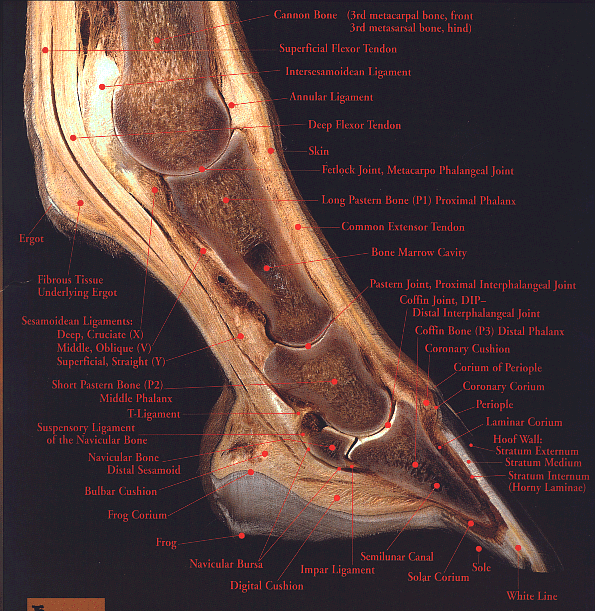
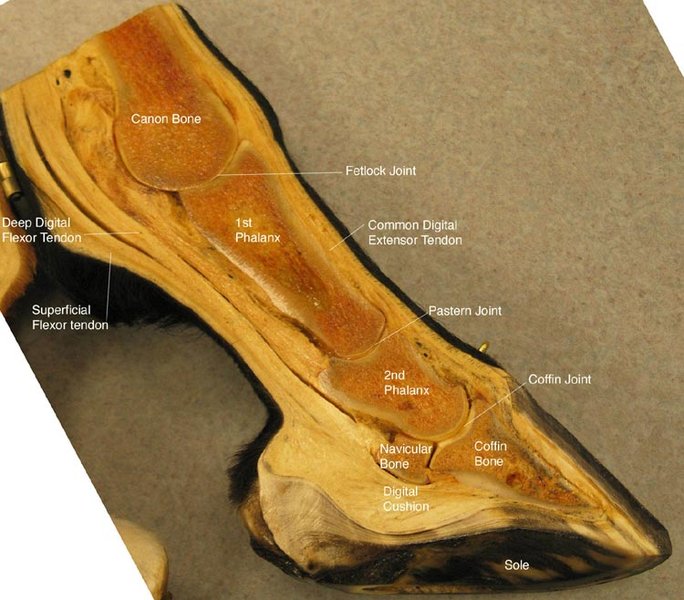
The picture below is a horse hoof and leg cut in half with parts labeled. If you click on the picture it will open a pdf file on Hoof Care, it is a large file and may take a while to download, but worth the read.
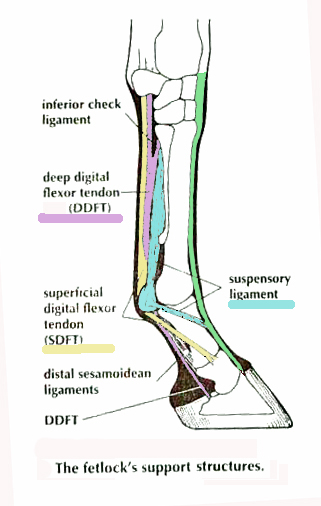
The Hoof Suspensory System:
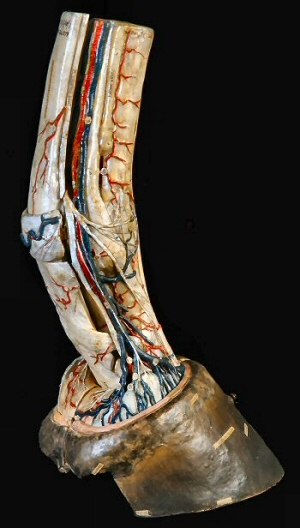
In the photo below you will see more of the complex support system for the horse"s leg and hoof. Clicking on the photo will take you a good site with lots of good information about the hoof.
Understanding Hoof Care:
Like many things in horses, "it is a process and not an event", so trying to fix a hoof or correct a horse in one trimming just makes matters worse. It takes a full year, thereabout, for a hoof to grow out completely. Another old horse saying is "the hoof you care for today - is the hoof you will ride on in a year". This means that when horses are neglected and are not given proper hoof care, it cannot be fixed in one or two trimmings. It takes time and "if you take the time it takes - it will take less time". So I see and hear people and Farriers claim to fix a hoof in one trim, it just ain"t so and can"t be done. You can start in the right direction; you can relieve pain, balance the hoof, start the repair process, but no hoof is fixed or made perfect in one trimming.
However, you can ruin a hoof in one trimming very easily. Which is why it is so important that you understand the mechanics of the hoof and know how it works, so you don"t buy into that foolishness that is being repeated throughout the horse world, mainly by people that don"t know and people "that have owned horses their entire life". Two horse sayings that fit here: "If you take the time it takes, it will take less time" and "The slow way is the fast way with horses."
Reference Glue on Shoes:
This is a new thing and is better than nailing metal shoes to the hoof wall and punching holes in the hoof wall with nails, which compromises the hoof wall, punctures the sealed hoof wall and subjects the Horse hoof to infection, abscess or bacteria. The next time you see a Farrier take off an old shoe from a horse, pay close attention to the hoof. Look at how the wall is dead about the nails, look at the rotting type action that occurs about the nails and where the metal shoe has restricted growth and blood flow. If you look closely, it is very easy to see how unhealthy the hoof is because of the shoe. However, with a fresh trim, some nipper work, some file work and a shinny shoe, the hoof looks all pretty again. What people don"t see is the rotting and damage that just starts over until the next change of shoes.
Shoes and nails still restrict the natural flexing, expanding and contraction of the hoof. It still puts unnecessary pressure on the hoof wall, still puts unnatural pressure on the hoof and still makes the hoof weaker in the long term, since it does not allow for natural and normal growth, blood flow and strength. So once again, trying to do something to improve or help a horse still goes against the natural growth and hoof development and ends up doing more damage than letting Mother Nature do what it does best. Barefoot is best.
Basic hoof care is not that hard, but it takes time. So trying to rush it or force it only makes it take longer. Like most things with horses, "the slow way is the fast way". So just picking the feet regularly really is a great way to prevent and spot problems. Picking the feet does many things that people don"t see. It teaches a horse to have his feet handled, it forces you to spend time with your horse, it develops muscles in your back which will help your riding, it shows dominance over the horse since you move his feet up and down and take away his ability to flee or run and most importantly it trains your EYE.
Training your eye is a process not an event. It takes years of seeing good and bad hooves to know what is normal and what is not. A trained eye is something that needs to be constantly refreshed. The eye is trained over years and years of looking at good and bad hooves. Seeing hooves daily helps you know what looks normal and what looks odd or out of place. This is how the eye gets trained. Which is why the misconception is alive and well that horseshoes are good? Since many use shoes and have always seen shoes on horses, they think that is normal. It is not and it is not good for the horse. I am linking many hoof sites to this page. Visit these sites and view all the pictures of good and bad hooves, train your eye to you know what you are seeing and what to look for. This is not something people naturally have or comes without work; they have to learn it. If you just look at your horse"s feet, you will never understand the hoof. It takes 1000"s of hooves to start being able to recognize good from bad. Some hoof chips are insignificant while others are very critical. Knowing the difference can save your horse lots of problems. So invest time viewing and reading all you can about the hoof. Watch Farriers work on feet, ask questions, notice the hoof before the trim and after the trim. This, like most all things with horses, is not easy and is not fast. If you invest on the front end you will save much more time and effort later and it will be better for your horse.
Another common misconception out there is that all hooves should look the same. This is not true; all hooves are rarely exactly same. Each hoof can be a little different; trimming all hooves the same can cause problems. If a Farrier or horse shoer is making your horse"s hooves look the same, then he is not doing your horse or you any favors. There are certain aspects of a hoof that mainly deal with "balance". Balance is important in many ways, but absolute uniformity is not the same as a well balanced hoof. If you view the links I have placed on the pictures and at the bottom of this page you will start to see what balance is and will hear this common theme from horse hoof experts.
A horse walks about seven to eight thousand steps a day in Pasture. A horse only walks less than 600 steps a day in a stall. This has negative consequences to blood flow, wear, exercise, flexing, frog stimulation and preventing all that is not good for the hoof.
Everything your horse eats will affect the feet. Some, such as excess sugars, grains and any toxins will have a very negative effect, while a well balanced diet will be beneficial to help keep the hoof health. Minerals, such as copper and zinc are essential for good hoof health. Too much iron is NOT good for the hoof. Although a mineral block and salt block is important, they may not provide everything needed.
Clean water and hydration helps the hoof. Having clean cool water in summer and warm water in winter helps a horse drink more and that is good for the hoof.
Hoof care and trimming are very important to a healthy hoof. Regular trimming keeps the hoof stronger, more balanced, shaped correctly and pressure points are reduced by keeping the hoof appearing flat, but actually level by smoothing off any lumps or bumps in the sole.
Laminitis is inflammation in the hoof. In my experience, Laminitis and abscesses are the most common form of hoof issues. So keep in mind, adequate exercise, proper diet, clean water and correct trimming will create and encourage a healthy hoof.
Remember: The front hooves carry more weight and pressure than the rear. Front hooves pull and back hooves push. Notice in the picture below how this happens.
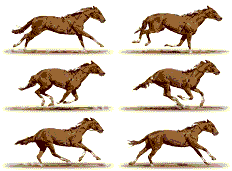
With this in mind, front hooves hit the ground harder and have more impact. Using easy boots or other type boot on the front feet is beneficial if you are riding on rocky or hard terrain, working longer or harder, or if the horse has been kept on soft or wet terrain making the hoof softer. A healthy hoof should not need boots.
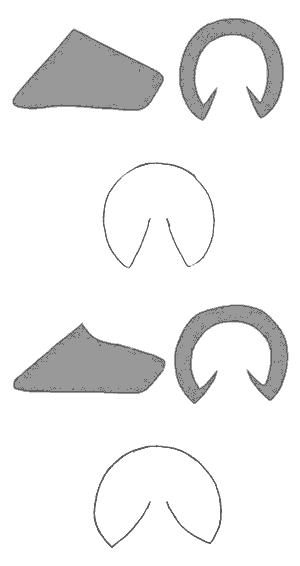
TWO KEY BAREFOOT TRIMMING POINTS: Rounding the hoof edge, commonly called a Mustang roll, helps prevents chips and increases hoof strength. SCOOPING, putting a slight scoop on the sides or quarters of the hoof, helps aid in flexing of the hoof when the horse walks (also called: Pooling). Here is two pictures of a scooped hoof, notice the raised portion of the hoof. When pressure is placed on the hoof, the front and rear hoof flattens and the scoop allows for flexing.
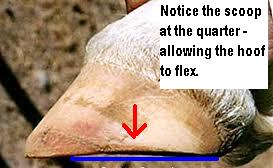
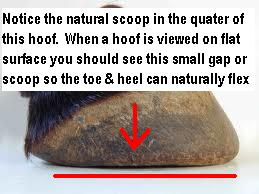
NOTE: You will NOT see scooping on a shod hoof (a horse with shoes), since shoes prevent flexing or expanding of the hoof, which is why Shoes are Bad for horses.
Hoof oils, lotions, conditions or treatments can do more damage than good - if over used. These things soften the hooves. Using them one or twice a month may be OK, but NOT sure they are beneficial. Using them any more will harm and make the hoof weak, slows growth, increases chipping and compromises a healthy hoof.
I got a question about how do horses in the wild get rocks out of their feet if no one picks them out. In the wild horses walk more, the run more, they get drinks in mud and ponds, they cross streams, and all of these things help remove objects from the hoof. When a horse kicks out at another horse or predator, that snapping action removes things from hooves. When a horse stands or walks in mud, that suction removes things from the hoof. When mud dries in a hoof and then when the horse runs, that dried mud flies off and pulls things from the hoof. When a horse paws with his front feet, that action helps remove things from the hoof. The more things we keep natural the better it is for the horse.
There seems to be a lot talk about square trims or 4-point.
Foot trims like most things are constantly evolving and changing. Some changes prove to be good, others not so good. Seems like everyone is always trying to copy the natural wild horse hooves, but our domesticated horse are not wild.
Wild horses travel up to 25 miles a day in search of food and water, they don"t sleep, stand and walk in their poop and urine or soaked footing in a stall. All these and other factors affect the hoof.
It is my understanding that the trim called the square toe, square hoof or 4-point trim is duplicating the same principles. By squaring the toe, you create a faster break over and trying to make the hoof hit the ground more flat or heel first. A quicker break-over results in less stretching of the tendons, a change in the timing and path of the hooves" pattern, and in some cases changes the way the hoof wears and absorbs shock.
This trim is sometimes used to help chronic founders, hock problems, interference problems. The basic aspects of this trim, if applied correctly, is said to help develop sole depth.
This is a good page on Barefoot Hoof Breakover
Bad trims or improperly trimmed hooves can cause lots of problems like range of motion, increases stress, more pressure on legs, joints and tendons and black hole, seedy toe or white line issues.
Most believe that Hooves should be round not square. Like many things, people can over do things and do too much causing more problems.
This page has lots of free articles and information about The Hoof, by Peter Ramey
My Advice for Basic Hoof Care
If I had to tell someone in 50 words or less how to care for a horse"s hooves here is what I say and what I believe. Pick the feet daily, spray a bleach mix once a week, learn how to use a rasp (file) so you can do a light "mustang roll" once every two weeks on your horse"s feet, round off and smooth out chips and cracks until your Farrier or trimmer comes out, watch your Farrier trim your horse(s), learn what the hoof looks like before the trim and after the trim and ask questions from your Farrier. Be involved and study what your horse"s feet look like after their trim. If you trim yourself "less is more." Always trim less; you will not do damage or harm if you remove too little. You WILL do damage if you remove too much. My basic rules for hoof trimming are; the sole and hoof wall should be about the same level. I do not trim or remove sole unless I see a lump or uneven spot, otherwise I let the natural removal take place as the hoof flexes and is walked on. I roll the edges of the hoof wall to make it stronger and help prevent cracks and chips. I rasp the hoof once every two weeks to remove small amounts of growth, chips or flares. I take off the bars but I do not take them too low - about even with the sole but better a little higher than the sole then too low. Length of the hoof is not the main issue, level, balanced and hoof wall and sole as one is key for me.
Some do"s and don"ts when it comes to Hoof Care / Maintenance:
Don"t over use conditioners and hoof dressings. Using these products too much interferes with the natural hoof development. It can make the hoof soft causing more damage, chipping and soreness. Don"t remove too much when filing with a rasp. Don"t use trimmers (nippers) this makes it too easy to remove too much hoof wall and if you are caring for the feet regularly, then you will not need nippers. A light rasping once a week or every two weeks will keep the hoof stable and will not create large changes in the hoof, like what happens when you just have your horse"s feet trimmed once every six or eight weeks. Keep a bleach mix (3/4 water - 1/4 bleach) in a spray bottle and spray in the hoof (frog area) after you pick the feet, about once every week or so. Do not do this everyday unless you smell a foul odor coming from the frog area when you pick the feet. If a foul odor is present, you can use this bleach every day but do not use it for over 4 or 5 days in a row since it will kill good bacteria if used too much or too often. And lastly, NO SHOES. Shoes are bad for horses, and transfer pounding and shock waves up the hoof, bones, tendons and legs. Shoes stop the natural movement and expansion of the hoof. In the picture below you can see the horse move naturally with NO SHOES. Nailing a non-movable metal shoe to a hoof stops and prevents this natural and needed movement. This movement is needed for blood flow and to keep a hoof healthy. Notice the hoof flexes many ways (front to back, side to side and flat), all stopped by shoes.
If you are switching to barefoot from shoes, give it time. The horse may be a little sore at first. Too many people want to say they tried barefoot and they took shoes off for one month and the horse was sore, so they went back to shoes. This is typical horse people wanting everything too fast and always in a hurry. It takes a hoof a full year to grow out. After years of putting nails and metal on the hoof and after all these years of screwing up the hoof, people want the hoof to adjust overnight to barefoot. "The slow way is the fast way;" give it time. There are many things to consider when going from shoes to barefoot.
Things that could matter are time of year, type of ground, how the horse is kept (stall or pasture), how the horse is used or ridden, how bad the hooves are, how the Farrier took off shoes, how the Farrier trimmed the horse and many other factors. So don"t expect overnight results and plan to have a few problems for a year until the hoof has had time to adjust to a natural hoof. Another thing is, if your Farrier wants or tells you that your horse needs shoes, don"t have them trim your horse barefoot, they can make the horse lame and sore so they can be right and then tell you that "they told you so." Then they get to convince you that your horse needs shoes or has bad feet. Expect your horse to get sore and may limp a little; that is normal. If you break your leg and get your cast off, you will still limp. The hoof may get sore after a ride since the hoof has never supported your weight or his weight without shoes. This will strain the hoof at first until it has time to grow and get strong. Do not take the shoes off, ride like you normally do, run the crap out of your horse, or jump and do all the other activities that are hard on horses feet and legs and expect everything to be normal and great two weeks after you remove the shoes. Impatient people always want the easy and fast way, so they make excuses that their horse NEEDS shoes since it is easier for them. Selfishness and not putting the horse first is all that really means!
I thought I would do a list of top 10 things to watch for and then as I was thinking, there are other things to remember and look out for when trimming your horses. Therefore, here is my list of things that I think are important about trimming hooves.
Less is more: It is better to take off too little than too much. It is better to trim a little every week than once every 8 weeks. Doing less changes the hoof slower and does not shock the horse"s balance or hoof.
The Hoof Wall: It is a capsule for the hoof. It holds many things together. Nails in the hoof compromises the hoof wall, which allows dirt and bacteria inside the hoof. The hoof wall protects the interior hoof, so making it thin or filing the sides weakens the hoof wall. The only part of the hoof wall that should be trimmed is the part that touches the ground. The hoof wall should not be shorter or higher than the sole.
Balanced and Level hoof: This is a guideline and not an absolute required perfection. The hoof wall should be about level with the sole, but should not be shorter. It is better to have a little long hoof wall past the sole than too short and have it higher and above the sole. Ideally, if the hoof wall is very slightly longer than sole then they will grow together and become tougher as one.
The Sole: The sole is not weight bearing and is also weight bearing, depending on ground surface type. In sand pressure is on the sole and hoof wall. On hard surfaces or concrete, the hoof wall should be more weight bearing than the sole. On barefoot horses, the sole is used more than on shod horses. The sole is naturally shaved or foliated so it wears down with use. I only remove sole when it is uneven and gets bumps or protrusions that go past the hoof wall. If the sole is thick, the hoof wall has to be longer than sole. If the sole foliates then the hoof walls become longer than sole since the sole is now shorter or higher. A balanced approach is best. Keep the sole and hoof walls almost even with the sole a little shorter or with the hoof wall a little longer.
The Bars: This again is said to be weight bearing and NOT weight bearing. If the bars are being pushed over and out then they are too long and are bearing too much weight. When dealing with bars, I think it is better to have them level with sole rather than longer or taller than sole. The rear of the bar helps determine the height of the heel.
The Heel: Another area that some say high is better other say lower is better. I say not too long or not too short. Too short is touching or almost touching the bulb. Too long is making the horse walk on the toe too much. Balance is better, the sole determines the heel height. Longer than sole is better than shorter than sole. The bars and sole come back and balance with the heel. If the heel is too short, the hoof is not balanced and the horse walks on the heel instead of the entire hoof. If it is too long, then more weight is on the toe and the hoof is not carrying the load balanced.
The frog: Some say trim short, some say do not trim. I think a little longer is better than too short. The frog wears down like the sole and the hoof wall. So it should not be shorter than the sole. Since the hoof flexes, it should touch or get pressure from the ground when the horse walks, but should not be lower than the hoof wall since that would cause too much pressure. So laying a rasp or straight stick across the hoof the rasp should touch both sides of the hoof wall but it should not touch the sole or the frog. If the frog touches the frog slightly with no pressure then that would be about prefect. That way when pressure from the horses weight is put on the hoof, then the frog will get slight pressure. The flexes is encouraged and assisted by pooling or scooping the quarters of the hoof wall.
Dealing with flares: Flares are caused by many things but normally by overgrowth of the hoof wall. If the hoof is trimmed every two weeks, flares will not happen since overgrowth is prevented. When a flare happens, it should be corrected from the bottom of the hoof wall and not so much from the side of the hoof wall. But if it is bad some slight shaving of the side wall may be needed. Flares unbalance the hoof, since one side gets more weight and pressure it causes the hoof wall to relieve that pressure by moving out or flaring. This also causes a separation of the hoof wall and sole, both weaken the hoof and put unbalanced pressure, which throws off balance and pressure so the horse"s weight is put on the quarter, toe or heel. This deforms the hoof as it grows. Prevention of flares is much better than correction of flares.
Dealing with Splits and Chips: Splits normally start as chips. They can also start from damage of the cornet band or damage to hoof wall. Chips on the bottom of the hoof wall can be managed and rounded to help prevent chips. When a chip happens it changes the balance of the hoof and transfers more pressure to other parts of the hoof. So by rounding and re-balancing the hoof slightly, you help prevent the chip from becoming a split. The more balanced the hoof the more the weight is distributed evenly so the less pressure points occur on the hoof. Again, a slight trim and rounding every two weeks keeps the hoof more balanced and even so minor things are corrected before they advance to more troublesome issues. More frequent trims also helps the hoof grow more evenly with even pressure and balanced growth, so that makes the hoof stronger. A stronger hoof supports weight more evenly, wears more evenly and functions better.
Scooping or Pooling Quarters: This is basically making the quarters a little shorter than the toe and heel. This is fine-tuning the hoof. By pooling or scooping the quarters, you allow a little spring or flexing action in the hoof whereby the toe and heel flatten out creating more movement in the hoof. This movement encourages sole growth and foliation, frog pressure and pumping action and increases blood flow to hoof. This is very easy to do too much, so remember less is more and better to have too little scoop than too much.
If this does not make sense or you do not understand the terms I used, then YOU need to do more reading and studying so you know parts of the hoof. Working on a hoof is like horsemanship, it is a process and not an event.
Side Note: In an article I read, it states that "Studies showed that the impact force a shod hoof receives on hard ground is 10-33 times that of an unshod hoof. The vibrations set up in the hoof by the vibration of the metal shoe is approximately 800 Hz, compared to "only" 150 Hz with a rubber shoe." That is just the horse, then add the weight of gear, people, running and jumping and people wonder we have so many lame horses. Those who know, understand that Horse Shoes Are Bad for Horses.
I get many questions on Thrush, treatments and home remedies. I decided to do a section about it to have something to direct people to when they ask. So here is some information.
DEFINITION:
Thrush has many names and is really a master of infection. It can be bacterial, Fungal, Yeast and or spores. Since Yeast feeds on dead bacteria, killing the bacteria feeds the yeast. Killing the thrush can kill good tissue and hoof so that is not good. Therefore, treating or killing this can be a viscous circle. Thrush is the equine equivalent of "athlete"s foot" of the hoof. Thrush is Anaerobic, meaning the bacteria does not do well in air. Which means it does really well in dark moist areas with little or no oxygen.
PREVENTION:
Picking the feet often removes mud, feces and other infectious material that can contribute to thrush. Having a horse NOT locked in a stall where it has to stand in it"s urine and feces helps prevent it. Allowing horse to be free in pasture to move, walk and get exercise helps increase blood flow to hoof and they helps prevent thrush.
TREATMENTS:
This is where it gets tricky. Every Farrier, Vet and horse owner has his or her opinion. I am going to list various treatments with some pros and cons. You can do your own research and make your own decision since each case of thrush can be different and each horse is different and in different environments. Most all treatments can include soaking the hoof and or packing the treatment into the hoof and deep into the frog area.
Boil 1 pint of water for 10 minutes.
Cool.
Stir in 3 tablespoons of chlorine bleach.
Stir in 1/2 teaspoon Baking soda.
Keep refrigerated for up to 5 days.
You may also purchase Chlorpactin powder over the counter, which can be mixed with water per package directions.
Here is a good PDF file about Chlorpactin Solution Uses and background
----------------------
Any athlete"s foot creme or antibiotic creme seems to be popular and effective
----------------------
Pick the hooves frequently to expose to oxygen and remove debris
----------------------
Chlorine Dioxide has been demonstrated to be bactericidal, fungicidal, virucidal and sporicidal while remaining harmless to healthy tissue.
Chlorine Dioxide Info
-----------------------
Soaking the hoof in Lysol and or spraying Lysol on the hoof
-----------------------
Destine or other fugal fighting creams seems to help fight the fungal part
-----------------------
Gold bond Foot powder in riding boots or put in hoof helps remove moisture and keep the hoof dry - a dry hoof tends to be a health hoof and does not promote thrush
-----------------------
Have a tube of desitin (dries the hoof), triple antibiotic ointment (for infection), an athletes foot cream (to fight thrush), and a tube of monostat (to fight yeast), mix well together and put in an empty syringe and insert into all parts of the hoof. NO needles and no internal injections, just forcing it into cracks and tight spots.
----------------------
50/50 mix of a triple antibiotic and anti fungal ointments
----------------------
Lysol Concentrate" to help with the infections affecting the frog area. You can saturate a cotton ball and insert it in between the central sulcus (bulb) area and frog area
----------------------
Soak the hoof for a half hour in 3" of water with 2 tbsp of borax helps clean and kill
---------------------
Betadine and hydrogen peroxide mixture - may kill good hoof
--------------------
Bleach and Water mix - 1/4 bleach - may kill good stuff
--------------------
Iodine crystals and turpentine
---------------------
Apple Cider Vinegar and a little water, specifically, Braggs. Vinegar in general is great for killing bacteria and helps balance the pH in the hoof
--------------------
Packing the hoof with sugardine, a mixture of sugar and betadine until it forms a paste
--------------------
hydrogen peroxide is oxygen rich but may harm good tissue
--------------------
Calendula Ointment and an Athlete"s Foot Cream (1% Clotrimazole). Mix 50/50
--------------------
Strong Lysol (strong smell). 1:1 ratio and used daily
--------------------
Some popular commercial products are:
Thrush Buster
Clean Trax - "The active ingredient in CleanTrax is oxyclorsine, The compound is non-necrotizing, extremely surface active and destroys bacteria, viruses, fungi and fungal spores on contact in either the liquid or vapor form."
White Lightening - "White Lightning" is the active Chlorine Dioxide (ClO2) solution to Thrush, Skin Fungus and White Line Disease. Chlorine Dioxide has been demonstrated to be bactericidal, fungicidal, virucidal and sporicidal while remaining harmless to healthy tissue."
Wd 40
NO Thrush
Foulex
Dri cow mastitis treatment, Keratex Hoof Gel - allows air stops moisture
Dry Cow mastitis treatment and then pouring Wonder Dust into the grooves on top of it and packing it in
Tomorrow "Dry Cow" mastitis treatment. You can buy it online at Valley Vet Supply.
Many different views on this, many factors that can change treatment results. I did a video on this topic where I discuss this
It appears that any anti-fungal, anti-Yeast, anti-bacterial all seem to be reasonable alternatives. Borax is found in some laundry detergents and appears to be a good anti-fungal and prevent mold spores, that is why it is used to clean water damage in homes. Do your own research, consult with your Vet and Farrier and do right by your horse. This, like horsemanship, is a process NOT an event. Hoof care, how the horse is kept, where and under what conditions the horse is kept, consistent hoof picking, hoof trims, diet, location and environmental conditions and many other factors all come into play when preventing or treating Thrush.
This site The Horse Hoof gives some good tips on treating Thrush, stinky hoof, whiteline and other issues with cleaning and treating the hoof.Research, Studies and Opinions On the use of Metal Horse Shoes -
Luca Bein, Swiss Cavalry, University of Zurich, Switzerland Veterinary Medical Faculty Scientist. "In 1984, the Swiss Cavalry conducted research into the effect of metal shoeing. Studies showed that the impact force a shod hoof receives on hard ground is 10 to 33 times that of an unshod hoof. The vibration in the hoof from the shoe is approximately 800 hz. This level of vibration is high enough to destroy living tissue."
Dr. Robert Cook, FRCVS, PhD, Professor of Surgery Emeritus at Tufts University. "All horses" hooves are healthier without shoes, and barefoot horses are healthier than shod horses. They live longer, happier, less painful lives. Barefoot is a requirement for health and should be accepted as a condition for keeping a horse. Humane management is not just preferable, it is nonnegotiable. The foot evolved to function unshod. Nature has developed the perfect design for grip and slide in all conditions and provided for unsurpassable shock absorption. The foot cannot expand and contract with each step when clamped. Blood supply to the foot is impoverished, and horn production becomes deficient. When the foot is prevented from functioning correctly, the pastern, fetlock, cannon, and knee are also placed at risk. This leads to bone, joint, and soft tissue injuries."
Dr. Tomas Teskey, DVM. "Every horse that wears steel shoes suffers some degree of laminar separation. There are a myriad of other malfunctions that also occur in a shod hoof, and they all contribute to the hoof functioning in a completely different and abnormal fashion and it leads to a severe contraction in their size, so much so that when the shoe is removed the horses can no longer walk comfortably on their own feet. For the presence of steel on a horse"s feet, we are able to observe profound damages that occur due to the stagnation of blood within the hoof and the diminished return of blood back up toward the heart through the veins of the lower leg. Metal shoes interfere with the hoof"s natural blood-pumping mechanism. Period. I will never ask any client of mine to consider shoeing their horse with steel. I have conviction in my belief about this and it is unwavering. I feel that farriers and veterinarians and trainers and horse people must learn the truth about this and tell their clients, friends and colleagues that shoeing horses damages them and robs them of years of their lives."
From The Unfettered Foot: A Paradigm Change for Equine Podiatry, Dr. Tomas G. Teskey, DVM. Dr. Robert Bowker, DVM. "The blood in horses" feet does much more than provide nutrients to hoof tissues. It also enables the unshod foot to function as a hydraulic system, in much the same way that gel-filled athletic shoes do. We need to be trimming hooves so that more of the back part of the foot-including the frog bears the initial ground impact forces and weight. Horseshoes provide a much smaller surface area to absorb shock. So if a bare hoof landing after a jump experiences, say, 1,000 pounds of loading per square foot, then with a traditional shoe, there"s going to be 2,000 pounds per square foot."
Note: I found this information on the web but the links were moved so I do not have direct links.
The Natural Hoof Care Advantage - by Dr. Tomas G. Teskey D.V.M. Arizona, U.S.A.
Ask your veterinarian, farrier or trainer about hoof care and the majority will freely admit that all equines are most healthy if they can be kept without steel shoes. Some believe, however, that shoeing is a necessary evil, evidently important for today"s working horses, mules and donkeys. Veterinary medicine has its roots in blacksmithing, branching directly from the iron-working profession. The two developed into their own specialties, but the hooves continued to be the "territory" of the iron men. With the ever-increasing knowledge of the hoof, farriery and veterinary medicine struggle for understanding and reason after a thousand years of tradition. As time marches on, a new paradigm for hoof care that does no harm is replacing methods that misunderstand the hoof. Given the latest exciting hoof research, the finest in hoof care today is focusing on maintaining normal hoof form and function to achieve optimum health:
- ensuring the hoof can flex in all directions to handle the terrain
- promoting fluid movement and circulation
- protecting sensitive structures inside the feet and legs
- wearing evenly through movement and growing in evenly and strong
- helping engage and sense the environment
These are all achievable with natural hoof care and impossible using steel shoes or improper trimming. In fact, placing shoes on hooves fixes them in two dimensions, forcing the joints above to twist and torque arthritic changes such as ringbone result. Normally shaped, healthy hooves are made of a specialized skin that can be conditioned to handle any terrain, flexing the proper amount to prevent damage to all joints in the body.
Shoes disrupt normal energy and circulation patterns body-wide, forcing the heart to work harder, stagnating energy flow and causing abnormal hoof growth. Healthy hooves pump large amounts of blood to keep themselves strong and all body systems vital and energized.
Instead of protecting the hooves, shoes cause concussive damage, promote weak growth and allow infection, heat and cold to invade the hooves, causing health problems for the entire body. Normal hooves are perfectly protective, insulate against temperature extremes and prevent injury from rough terrain.
Hooves can"t wear themselves when shod without a little bit of normal wear, they become deformed and infected with fungus and bacteria. Exfoliation keeps hooves healthy and free from infection and stimulates strong, new growth.
Shoes prevent the horse from sensing the earth and their own hooves, stumbling, loss of traction and increased injuries result when shod. The loss of a shoe and the lameness that follows demonstrates the underlying unsoundness of the shod horse. If shod horses suffer no ill effects from their shoes, as many professionals contend, why are they so lame within minutes when walking a short distance without them? Soundness in horses has come to mean moving with animation and impulsion on unfettered feet. These horses appreciate normal sensation and feel comfortable around us, place their feet accurately, with superior soundness and traction, keeping themselves and their riders safer. When in need of protection on rough terrain or during rehabilitation, flexible, removable boots that complement hoof form and function are most appropriate, providing superior protection and doing no harm to the horse.
Just as it was a change in horsemanship practices that allowed horses" health to deteriorate, so a change in horsemanship is required for them to regain their vitality achieving peak performance takes more than just trimming hooves a certain way. Proper nutrition and lifestyle are critical for success. Natural horsemanship practices today go hand in hand with natural hoof care together they are unbeatable! These horses and their astute caregivers are leading the way in all parts of the equine industry, demonstrating the efficiency of the natural hoof care paradigm which raises horses with superior hooves and prevents all common hoof diseases. These are the priceless advantages that are bringing horses and their owners greater enjoyment all over the world.
More valuable and exciting information is available on www.easycareinc.com, www.equethy.com, www.hoofrehab.com, www.equinextion.com and in an upcoming book by Dr. Teskey which explores the details required for achieving and maintaining a sound high-performance horse.

This is called many names it is basically a trap chute where the horse or cow is locked in while standing and then it is tilted on its side and the feet are trimmed.
Click Here to read the Article, in full PDF, with Pictures
Published in Animal Welfare Science, Ethics and Law Veterinary Association Journal
METAL, MYTH & EQUINE MISERY
PRIMUM NON NOCERE (First, do no harm) - Hippocrates (c. 460-377 BC
When we talk of horses the word "technology" does not immediately spring to mind. Yet there are two technologies that have been intimately associated with the horse for so long that we overlook their invidious nature and accept them without question: the bit and the horseshoe. The good news is that harmless alternatives to both technologies have now been developed, tested and widely practiced. The bit can be replaced with a cross under design of bitless bridle1, 2 and with simple management changes a horse can go barefoot.3-5
Two big myths
Invention of the bit facilitated the domestication of the horse, six thousand years ago. Early bits were probably made out of plaited vines, followed by wood, antlers and bone. Metal bits of the Bronze Age were the forerunners of today"s stainless steel bits. The most ancient of bits are instantly recognizable for what they are and we don"t need an archeologist"s interpretation. The principle and mode of action is unaltered. One or more metal rods are inserted into a horse"s mouth and held in place by means of a bridle. A rein attached to each side of the bit is manipulated by the driver or rider (Fig.1). To this day, most horsemen believe that a bit controls a horse when, in reality, the bit is the most common cause of complete loss of control. Though horses have been bolting, bucking and rearing their way through history, this "control" myth survives all evidence to the contrary.
Fig. 1 Radiograph of a double bridle in situ, consisting of a bridoon bit, a curb bit and a chin chain. The long shanks with one set of reins attached to the bottom ring permit pressure from the curb and chain to be leveraged, applying a thumbscrew action on the mandible. At the level of compression, the mandible in cross-section is no bigger than a mid-section through a standard hen"s egg. (Fig 2) Robert Cook
Fig 2. On the left, a transverse section through the mandible of a draft horse at the level of the bars of the mouth (the two knife-edges dorsally) on which the bit is brought into contact when a horse is "on the bit." The red beads represent the mandibular branch of the trigeminal (sensory) nerve. On the right, a mid-section through a standard hen"s egg.
The horseshoe is a medieval invention. It was in common use by 900 AD and is proudly depicted in the 11th century Bayeux tapestry on the fettered feet of William"s horses. Again, over the ensuing millennium, neither the design nor the principle has changed. A metal hoop is applied to the solar surface of the hoof and fixed in position by a series of nails driven through its wall (Fig.2). Today, most horsemen still believe that the purpose of the horseshoe is to protect the hoof. But evidence gathered in the last 25 years shows this to be incorrect.9-11 In fact, shoes cause serious harm to the hooves and ultimately to the whole horse.12 Properly managed (i.e. neither stabled nor shod) a horse can be used for all the extraordinary purposes that man expects of his "best friend", including hundred mile endurance races over rocky terrain. There is only one exception. Specially designed shoes are still necessary for Western style reining competitions, where (highly unnatural) sliding stops are a required part of a performance. Yet the "protection" myth lives on in all other disciplines.
Fig 3. Radiograph of a shod hoof showing a common fault. The heel of the hoof is abnormally high and, as a result, the solar surface of the third phalanx is not parallel to the ground as it should be for proper weight distribution. Increased stress is placed on the sensitive laminae of the wall. This 19 year-old horse had severe laminitis with rotation of the third phalanx and penetration of its tip through the sole. Barefoot management restored the horse to health. Photo Claudia Garner
Persistence of old ideas
As John Maynard Keynes wrote, "The difficulty lies not in the new ideas, but in escaping the old ones, which ramify, for those brought up as most of us have been, into every corner of our minds, like the clinging roots of an old juniper."
Several factors account for a horse still being in irons:
There are not many technologies in use today that are unchanged since the Bronze Age (bitting) or Saxon times (shoeing), nevertheless, "undiscovered crime" is undoubtedly a factor. It was not until the end of the last millennium that the many harmful effects of bitting and shoeing were fully recognized
In the absence of an acceptable alternative, bitting and shoeing have been justified as necessary evils. As far as bitting is concerned, it has long been a fundamental assumption on the part of English style riders (though not Western) that there is no alternative to a bit. Similarly, shoes have been regarded as indispensable for serious riding or driving. By definition, as it were, a stabled horse must be shod. It has not been recognized that stabling in the first instance results in the poor hoof quality that now "requires" shoeing to "protect" the hoof. Tradition and custom is a potent cause for the persistence of a practice. Horsemen are conservative by nature and tradition alone has become a reason for resisting change. But tradition is not a sufficient reason for maintaining a practice when new knowledge shows that tradition is not consistent with good welfare, i.e. the physiological needs of the horse.
There is always a time lag between research being completed and results being applied. Passage of a whole generation has not been uncommon. In this age of information, one might hope that such a time lag would not occur over matters concerning equine welfare. Unfortunately committees make rules and regulations and such bodies are vulnerable to what social scientists call a cascade and the problem of mistaken consensus. If one person on a committee "gets it wrong" and is confident enough in his rejection of a new idea, he "infects" others and there follows a cascade of misinformation. But science is not a democracy and the acceptance of scientific advances should be decided on the evidence and not on a majority vote influenced by crowd behavior.
Finally, there is the "not in my back yard" problem. The introduction of a new idea brings with it an element of the unknown and unfamiliar and this, in turn, raises the spectre of litigation. Administrative bodies are inclined
"In England we have come to rely upon a comfortable time lag of fifty years or a century intervening between the perception that something ought to be done and a serious attempt to do it."- Herbert George Wells 1866-1946 , to wait until some other organization has taken the first plunge. Individuals, on the other hand, are more open to new ideas. It is heartening to witness the enthusiasm with which many thousands of riders and drivers have already adopted the bitless &/or barefoot way and are showing by example.
Equine Misery
Rose Macaulay wrote, "Behaviour of such cunning cruelty, that only a human being could have thought of or contrived, we call "inhumane", revealing thus some pathetic ideal standard for our species that survives all betrayals."
The British Veterinary Association"s Ethics and Welfare Group updated the working definition of "animal welfare" recently as relating "to both the physical and mental wellbeing of the animal." The inclusion of mental wellbeing is especially relevant to the horse, a prey animal that for its evolutionary survival - is dependent upon being easily frightened. My own research has revealed the high degree to which the pain of a bit frightens a horse. It triggers flight, fight and freeze responses that, in man"s environment, are dangerous to both horse and rider. Simply from the point of human safety it is not a good idea to frighten an animal as powerful as a horse. Apart from the fact that a rider loses control of a frightened horse, it is inhumane. The oral cavity is one of the most sensitive parts of a horse"s anatomy. It is inhumane to place a metal rod in a sensitive body cavity and apply pressure. "To rule with a rod of iron" (or try to) is to rule tyrannically. Interestingly, the manipulation of an instrument (a bit) in a body cavity (the mouth) could be considered an act of invasive surgery. The word "surgery" derives from a Greek word that means, literally, "a working with the hands." If the bit had never been invented and some scientist today submitted a research grant proposal that involved such "surgery" on a conscious horse, the proposal would be hastily rejected by any reviewing board.
As Noel Coward didn"t say, the bit has a talent to abuse. It is responsible for over 100 examples of negative behaviour, most of which are triggered by pain and fear and some of which are fatal to man and horse.8 If a medication had half as many serious side-effects it would be withdrawn from the market. Apart from what might be described as the "scared horse syndrome" the bit causes over 40 different diseases.7 Physical health is certainly affected as well as mental health (Fig 3). A number of the bit-induced diseases were previously categorized as idiopathic, such as dorsal displacement of the soft palate, epiglottal entrapment and asphyxia-induced pulmonary oedema ("bleeding" in racehorses).
Fig. 4. Showing some of the physical trauma to the jaw and teeth caused by a bit. 1 = bone spurs on the bars of the mouth; 2 = erosion of the first three cheek teeth from constant bit pressure and a horse trying to defend itself by "grabbing the bit"; 3 = shedding of the first cheek tooth; 4 = periostitis of the empty alveolus. Compare with the normal jaw above Robert Cook The misery caused by shoeing is obvious in different ways but just as serious. Whereas some of the harmful effects of bitting become apparent even on day one after removing the bit, the improvement in welfare after removing the shoes takes time to become apparent. Whereas the bit"s effects are acute in nature, the shoe"s effects are chronic.12 Shoeing acts like a slow poison. Its effects are cumulative and it may be years before a serious problem surfaces, such as navicular disease or laminitis. The delayed action of shoeing has sheltered it from being discovered as the true cause of these two common scourges. Sadly, because deformity of the hoof by this time is advanced, it can take months or even years before normality can be restored by a barefoot management program (Fig 8). The clinical signs that result from traditional management (i.e. stabling and shoeing) include intermittent or persistent lameness, poor hoof quality, sand cracks, seedy toe, solar bruising, contracted heels, and reduced shock absorption leading to ossification of the lateral cartilages and stress on joints and ligaments. Inability of the hoof to fully dilate and contract with intermittent loading impairs circulation to the foot. It also impairs systemic circulation as healthy hooves act like four supplementary cardiovascular pumps, something that is especially necessary at fast exercise. As with the bit, a clinical sign easily overlooked is inability to carry out the work required and premature death.
Fig. 5. Showing how long-term shoeing causes deformity of the third phalanx. Compare the shape of the normal third phalanx in the middle, to the two deformed bones above and below. Hiltrud Strasser
Relief of Misery
Replacement of the bit with the crossunder bitless bridle provides painless and more effective rider/horse communication for all disciplines, and for all types, breeds and age of horse (Fig 6).2 The method is usable by riders of all ages and experience from novice to professional. It enhances a rider"s skills as it encourages the use of seat and legs rather than hands.
Fig. 6: Showing a caudo-lateral and ventral view of the crossunder bitless bridle. A squeeze of the right rein (yellow arrow) nudges the entire left side of the head (red arrows), painlessly signaling "steer to the right." An intermittent squeeze on both reins hugs the whole head, signalling "slow" or "stop."
Fig 7. Showing a rider using the crossunder bitless bridle during a hundred mile endurance ride, the U.S.Tevis Cup. Photo Logos Hall/Hughes Photography Removal of shoes and the institution of a barefoot management program (24/7 turnout and trimming as required when overgrowth occurs) enable a horse to be ridden over all terrains from rock to sand and under all conditions, including ice and snow. Barefoot horses perform to advantage in all disciplines.3 Fig. 8. Showing a healthy (unshod) hoof at the end of a 100-mile endurance ride. The horse had completed a 50-mile ride 48 hours earlier. Photo Darolyn Butler
Impediments to Relief
There are no contraindications to bitless or barefoot management from equine health or the equestrian"s point of view. The only impediments are of an administrative nature. For example, the Federation Equestre Internationale (FEI) currently mandates the use of one or more bits for the discipline of dressage and for the dressage phases of other disciplines. This brings about the bizarre situation whereby a bit is required for dressage but not for the more dangerous cross-country and show jumping phases of eventing. National federations follow the FEI lead. The FEI influence even cascades down to Pony Club level, so children with less than perfect hands are obliged to use instruments of torture. As a result, their ponies become "hot" and difficult to handle. The stewards of racing currently require a horse to be raced with a bit.
There are fewer administrative rules that require shoes for competitions. But sadly an impediment to the freer adoption of barefoot management programs comes from farriers and our own profession. At present, relatively few veterinarians and farriers have studied the barefoot research. So owners are unable to look to these professionals for help in transitioning their horses from shod to barefoot. This will change in time.
Conclusions
The horse cannot be "supplemented" with steel rods in its mouth and steel hoops on its feet without interfering with its physiological efficiency. It is as though one takes a computer and expects it to work after you have driven a couple of iron stakes through its casing. We "supplement" the horse at our peril. Bits and shoes are weapons of horse destruction. Bitless and barefoot management represents state-of-the-art non-technology.
Cruelty has been usefully defined by David Morton as the infliction of avoidable pain and suffering. Now that physiologically compatible alternatives are available to the pain and suffering inflicted by bits and shoes, both of these primitive technologies are now avoidable. Being avoidable, their classification undergoes a sea change. By definition, bitting and shoeing are now cruel practices.14 It is to be hoped that the administrative bodies of horse sports worldwide will quickly update their rules to bring them into line with these two historic advances in equine welfare.
Reprinted: Andi Varkonyi Published in Animal Welfare Science, Ethics and Law Veterinary Association Journal
Here are some good pictures of healthy hooves
This site has a lot of selling and pushing items (not endorsing any products), but has good pictures of good and bad hooves
More good hoof information: Equine Lameness Prevention Organization
Here are some good pictures of hooves before and after trims
Here is a nice report that explains the importance of Breakover and heal verses toe landing.
Here is a great article on What You Need To Know About Trimming.
Here is an article on transitioning from shoes to barefoot. There is a great explanation that says "THE REASON FOR THE PROBLEMS ENCOUNTERED AFTER REMOVING THE SHOES IS THE HEALING OF A DEFORMED HOOF, ALTERED FROM ITS NATURAL, PHYSIOLOGICALLY SOUND SHAPE."
Finally Dressage is putting horse health above tradiction. Dressage Barefoot is catching on.
Here is a lot of good photos of the hoof before and after barefoot trimming.
This is a good article on why barefoot is good for horses. Barefoot for Soundness.
This is a good article on issues, problems and considerations when moving from shoes to barefoot. Going From Shoes to Barefoot.
Good Info on bad hooves. Peter Ramey Rehabilitations.
Here is a picture of severe White Line Disease that has been neglected and has eaten away at the hoof. The pictures show the progression and healing of the hoof with proper BAREFOOT trimming.
