Horsemanship Pages
- *Home
- *Sitemap
- *SEARCH THE SITE
- *Horse History
- *Horseman Tips
- *Horsemanship
- *Amazing Horse Hoof
- *Horse Anatomy Pictures
- *Rope Halters
- My Random Horse Thoughts
- *Tying A Horse
- *Bosal/Hackamores
- *Bad Horsemanship
- *Misc Horse Info
- *Trailer Loading
- *Training Videos
- *Hobbles
- *Horse Articles
- *Health and Medical Info
- Horse & Rider Fear
- Opposition Reflex
- *Answers to Questions
- *Cowboy Wisdom
- *Cookie Recipe for Horses
- *Horse Jokes
- *Cowboy Weather
- *Sites and Links
- *A Horse's Prayer*
- *Photos Rick and Horses
- *Clinics on Request*
- *Contact Rick
Think Like A Horse - Horse History
Rick Gore Horsemanship

Horses love it when their owners understand them.
Horsemanship is about the horse teaching you about yourself.
History of the Horse

This page covers horse history and how the horse has contributed to man over the years. It contains interesting facts and shows how the horse has been used by man to get mankind where it is today. I hope this gives people a better understanding of the horse, where it has come from, and the sacrifices it has made. I would ask you to ask yourself these questions while reading this page, without the horse, where would mankind be today?

Cave paintings of horses dating to 31,000 BP (before present). All of these paintings frequently show the horse as an object of prey. Yet these prehistoric cave paintings also reveal the great majesty man saw in the horse and show the great effort he made to recreate this beauty on the lasting canvas of the cave's rock walls.
The Scythians' wealth was counted in horses. There was a belief in the continuation of material life after death caused the wealthy to take quantities of horses with them into the grave. In one case, 400 horses were killed and buried with one man to show his importance.
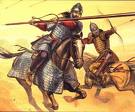
25,000 year old frozen remains of horses identical to today's wild horses have been found in the Arctic Tundra.

Horses have been found that are 6000 years old that have bit marks on their teeth. This indicates that horses were ridden long ago with bits. Pain control devices are nothing new to the horse. The tradition of training through fear, pain and intimidation has been carried on and still continues today.
Ancient Man Held the Horse in Awe, Placing Equus among the Gods. Cultures of the ancient world evolved various mythologies, bodies of legend and belief that reflected their values, ideals, and visions of the past. The presence of the horse is common to many mythologies.
Poseidon Creates the Horse from the Ocean's Waves. A Roman mosaic of the third century AD shows Poseidon, the god of the sea. In India, ancient gods drove chariots across the sky, some chariots carrying the sun.


Few legends reveal such a close relationship between man and horse as that of Alexander the Great and his horse, Bucephalus. Son of King Philip of Macedonia, Alexander was tutored by Aristotle in academic matters and studied horsemanship with his father. When he was 12 years old, Alexander found, in his father's herd, a young horse, which he admired for its great beauty. The boy named the horse Bucephalus because his head was broad, like that of a bull. The horse would not allow anyone to ride him except young Alexander. The two grew up together and developed a deep bond of love and respect between them. Later he named a great city after his horse.


In 431 BC, Xenophon was known as a great horseman. He believed in taking care of horses and treating them with respect and admiration and not just as a beast of burdens. He was probably one of the first true Natural Horsemen, although this word was not around back then.Xenophon was a Spartan Officer who studied under Socrates and was called one of the original "Horse Whisperers".

In 1286 BC, in an Egyptian battles over 7,000 horses were used to fight. In 476 AD, the early Roman army was primarily infantry based and was not heavily reliant on cavalry. As the demand for mounted troops rose, the Romans incorporated into their auxiliary corps cavalry units representing many of the finest equestrian traditions of the western world. These included cavalry from present-day Hungary, Germany, France, Holland, Spain, Morocco, and the steppes of Ukraine and Georgia.

Hipposandal: The Romans used a metal sandal tied on with leather straps to protect their horse's feet. This was before nailing a shoe on a horse was accepted. Nowadays, this is called a barefoot boot made of hardened plastic and held on by Velcro or wire.

At one time, the Romans maintained up to 14,000 horses for chariot racing, and there was always a demand for more. Horses began training as two-year olds, were put into training harnesses at three, but were not raced until they were at least five years old. They received only the very best care by skilled grooms and trainers. To insure the horses' tranquility before a race, the Praetorian Guard (the elite guard of the Roman emperors) were instructed not to sound their trumpets so that the horses would not be disturbed.

Epona - Protector of the Horse - The ancient Celts worshiped the mythical figure Epona, the goddess of horses.
The fall of the Roman Empire began the medieval period or middle ages, which lasted some seven hundred years. The early middle ages are sometimes called the dark ages since the glories of the former Roman Empire virtually vanished. These were times of religious wars and barbarian invasion. The horse became largely a vehicle for battle or the hunt.The Middle Ages saw the horse adapted to new roles in such diverse areas as warfare and agriculture.

Throughout Western Europe, the armored knight and his specially bred "great horse," now with the benefit of the additional stability provided by the stirrup, would dominate the European battlefield for the next 500 years and issue in the age of chivalry.

Why do many people place a horseshoe over their door to ward off evil? One legend states that in England in the tenth century, there lived a blacksmith named Dunstan. One day the Devil came to Dunstan's forge to have his cloven hooves shod. Dunstan agreed to make the Devil's shoes, but instead he lashed the Devil to the anvil and furiously beat him with his hammer. The Devil begged for mercy. Dunstan made the Devil promise never to visit a door where a horseshoe hung.The Devil quickly agreed and since then, blacksmiths and others have placed a horseshoe over their doors. The horseshoe must be placed with the toe down so that it can catch goodness from heaven. And what ever happened to the noble Dunstan? He became the Archbishop of Canterbury (961 - 980 AD) and was later made a saint after his death.

In 1066, William the Conqueror of Normandy put approximately 3,000 horses on 700 small sailing ships and headed across the channel to England. William had come to secure his right to the English throne from King Harold. Transporting William's horses across the English Channel created a logistical nightmare - one that would be faced to some degree by all future mounted armies in the field. William assembled his men and horses on the French coast approximately one month prior to the invasion. Extensive research has been done into the logistics of supporting the equine element of a force of this size for this period of time. His calculations assumed that the majority of the Norman's warhorses stood approximately 15 hands and weighed between,300 and 1,500 pounds; each would have thus required around 25 pounds a day in hay and grain. Based on these assumptions, he concluded that the horses would have needed:

--9,000 cartloads of grain, hay and straw, and 750,000 gallons of fresh water and produced 700,000 gallons of urine and 5,000,000 pounds of manure
-- 5,000 cartloads to remove the waste
--8,000-12,000 horseshoes and around 50,000-75,000 horseshoe nails, formed from approximately 8 tons of iron forged by skilled workers into shoes and nails
--10 Farriers at a minimum working 10 hours a day, 7 days per week to affix the shoes to the horses

In the years of the Knights, their reins were covered with metal plates to protect them from being cut by an opponent's sword. The horse could not be covered or protected from the swords and many were lost.
Temujin, later known as Genghis Khan (1162-1227) was born in 1162. At the time of his birth, the Mongols, their horses and their riding tradition were their strengths.The Mongols relied on the tough and hardy Mongolian horse. These horses generally stood between 13 and 14 hands and were in plentiful supply.

Prior to the Middle Ages, horses were mainly utilized in transportation and warfare. Moreover, horses were both expensive to buy and compared to oxen and donkeys who were foragers, were expensive to keep. Horses required specialized feed, constant care, and good shelter. The feudal system of the Middle Ages placed the farmer on his land under the control of a lord, but the lord, in turn, had the means of supplying the farmer with horses to use in the manor's fields. Therefore, the Middle Ages saw the horse slowly begin to replace the ox in agriculture. This transformation would not be completed until the 19th century.

In the Middle Ages, hunting the stag (fox) from a horse became a very popular sport, especially in France. By the time of the Norman Conquest, the stag hunt was enjoyed by most noble Norman gentlemen.
Leonardo Da Vinci's art ranks at the very top of the long list of Renaissance masters. Leonardo studied the horse's skeletal and muscular systems, as well as its motion, with both insight and accuracy. Some of his most detailed pieces are of the horse. Picasso also has some famous paintings with horses.

The sport of polo enjoyed great popularity in the Middle East and later China, Japan and India, where it was a popular form of recreation for the sons and daughters of royalty. Polo did not become a Western pastime until 1869 when British officers brought the game home from India.
In 1382, the coach became popular in England and mail was delivered by horses.
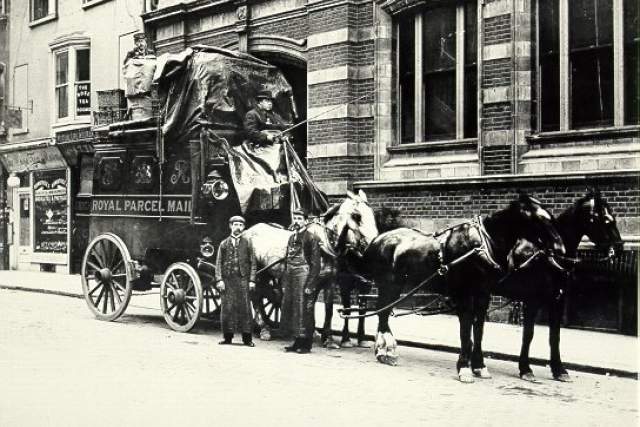
Renaissance literally means "re-birth." Between 1450 and 1650, vehicle design was advanced and horses assumed a more prominent role in the transportation of goods and people.
When Cortes landed in what is today Vera Cruz in 1519, it was the first time that horses had set foot on the mainland of North America for more than 10,000 years. His proclamation concerning his horses had much meaning. In addition to simply carrying the conquistadors, the horses were feared and held in awe by the Indians. Bernal Diaz del Castillo, who accompanied Cortes in his incursion into Mexico, wrote "The natives had never seen horses up to this time and thought the horse and rider were all one animal. "Cortes' contingent had only 16 horses, yet the Indians' astonishment at these "horse-men" contributed to their submission to the conquistadors.

One of the first laws passed by the Spanish conquerors prohibited any Indian from riding a horse.In 1541, however, Viceroy Mendoza put allied Aztec chieftains on horses to better lead their tribesmen in the Mixton War of Central Mexico. This appears to have been

the first time that horses were officially given to the Indians.Indians were seen to rub themselves with horse sweat, so that they might acquire the magic of the "big dog."

William Cavendish, the Duke of Newcastle (1592-1676), served as a cavalry officer on the Royalist side in the English Civil War. He urged that training be based on understanding and patience, not the coercion that was still the rule of horse training. As one modern commentator points out, "He was the best riding master of the seventeenth century."

To protect the horses in transit, slings were constructed to allow the horses to swing with the roll of the ship, and to take the weight off their feet. Confinement in damp, dark holds and lack of exercise took its toll on equine emigrants. Sometimes half of the horses died en route to America. That section of the Atlantic Ocean known as the "Horse Latitudes" gained its name from the sad fact that innumerable dead horses were thrown overboard into the ocean during these early voyages of colonization. Before wharves were built, the horses were lowered into the water and made to swim ashore, led by men in rowboats.

In the 1600s, an Italian horse trainer and his horse performed in front of God-fearing peasants in France. These people burned and killed the trainer and his horse. To them, natural horsemanship had to be connected to the devil. Man was convinced that a horse had to be controlled by muscle, force, fear and violence. So anyone not using these methods must be connected to evil. Being the ultimate predator that man is, it is always easiest to resort to his primal aggressive traits.

The 1600s were exciting years in the history of man and horse alike. New ideas in government led to social change, sometimes revolution. People sought new lands where they could live as they chose. The horse was put to increasingly more diversified uses. It became a servant for colonists, sometimes plowing fields and frequently carrying people and goods over difficult terrain.
Ponies are frequently seen grazing on the farms near coal mines. Most of these rugged little ponies are descendants of pit ponies, which were used to haul coal from mines as early as the 1600s.

When coal was first mined in America, breeds such as the hearty Shetland ponies from northern Scotland were imported in great numbers to work in the mines of Pennsylvania, Ohio, West Virginia, and Kentucky. Many ponies were born, raised and never saw daylight before they were put to work pulling carts of coal. Because of the lack of fresh air, many died at young ages.

Innovations in Military Weaponry and Tactics in the Early 1600s Led to a New Role for the Horse in Battle. The development of firearms greatly affected the use of the cavalry horse. In this century horse training consisted of tying a cat, belly up, on a stick and having a man shove the cat under the horse if he did not respond to spurs and whips. The cat would scratch, claw and tear at the horse's private parts. And this was called training?

Many towns and cities in America have streets called "Race Street". Such streets gained their names from the habit of running horse races on them. In 1674, the citizens of Plymouth, Massachusetts evidently grew tired or frightened of the races in their villages, and created an ordinance forbidding racing.
A law was enacted by William Penn in Pennsylvania in 1687, which set a minimum height of 13 hands for free ranging horses. Any horse more than 18 months old and less than 13 hands had to be gelded.

Early American roads were merely Indian paths, only passable on foot or horseback. Horses were scarce in colonial America, so an ingenious system of sharing a horse was devised based on "ride and tie." One man started out on the horse while the other began walking. After a set distance, the rider would dismount and tie the horse to a secure object. When the other man had walked to the tied horse, he mounted and rode past the original rider to the next tying point. In this fashion, each man got to ride part way and the horse even got some rest!

The Quarter Horse is one of the original American breeds of horses. The precise origins of the Quarter Horse have been argued incessantly and vigorously from its very beginning. The oldest ancestor of the Quarter Horse is the Hobby, which was imported in numbers to the mid-south in the 1600s and 1700s. The most decisive influence on the Quarter Horse came from the Thoroughbred sire, Janus, imported as a 10-year-old to America in 1756. Janus stood at stud for 24 years, but the origin of the mares he was bred with is the subject of dispute.

The alliance of the American Indians and the Spanish horse gave the Indians great mobility and changed their way of life. Tribes with horses were dominant over other tribes who relied on moving camp on foot. Horses and horsemanship gradually spread from tribe to tribe until by the 1700s the plains Indians were becoming some of the finest light cavalry and mounted hunters the world had ever seen.
Until the mid-19th century, horse racing was the principal form of organized sport in America. Modern towns have athletic rivalries on the football field. In colonial America, town rivalry was centered on horse racing. Typical wages included money, tobacco, slaves, and property. Tempers frequently ran high if a start was questioned or if one rider allegedly interfered with another. Thus, the official who started the race was selected as much for his brawn and his ability to defend himself as for his honesty.
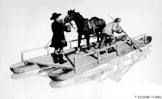
In the days before bridges, it was not easy to cross a river or a swollen creek with a horse. Many horses would refuse to swim the stream, regardless, the rider was sure to get wet. The alternative was to search out a farmer with a ferry. Ferries were often no more than a deck and rails attached to two dugout canoes. Two parallel boards with cleats across them served as a gangplank for bringing the horse aboard. A gangplank was kept on each shore. Most horses would board easily, but now and then, a nervous horse would have to be blindfolded. The horse was kept in the middle of the board by cross-tying him to the boat's side rails. The average fee for ferrying a horse and rider was about 12 cents.
Most people traveled by horseback in the 1700s, while some endured uncomfortable journeys by public stage. Two big horses normally pulled the stage wagon, but in bad weather four horses were needed.

In the late 1700s, California was colonized and missions were established throughout the state. Spanish Mexican Vaqueros were becoming known for their exceptional trained horses. After the Civil War (1865), the railroad developed Texas and the Texas cowboy emerged. These cowboys took after the Vaqueros and practiced their training methods. Although the Vaqueros produced some excellent horses, their methods were crud and still used pain and intimidation, and did not include Natural Horsemanship.
The founding sire of the Morgan breed was a legendary horse named Figure, who later became known by the name of his breeder and first owner, Justin Morgan. Morgan, from West Springfield, Massachusetts, was a well-known and respected singing master and composer during the 1700 and 1800s. Morgan also owned a tavern and maintained stallions at stud to supplement his income.In 1791, Morgan relocated his family to Randolph in the independent Republic of Vermont.
George Washington was a General, the first President and was known as a Great Horseman. Thomas Jefferson called him the best "Horsemen" of the era.

In about 1781 he was thrown from his horse, named "Eagle", and broke his arm. He would have been in his early 70's at that time. Later, while in his 80's, he and Eagle were crossing a rapid stream and he was washed off his horse, he was able to grab Eagle's head stall and was dragged to safety by his horse. Just one more significant contribution of the horse to our country. How many other animals have saved the life of a President? Was our national symbol, an Eagle, selected for this reason? Only history knows for sure.
The term "stagecoach" is derived from the fact that these vehicles traveled in segments, or "stages" of 15-20 miles in length.

At a stage stop, horses would be changed and travelers could refresh themselves or sleep for the night at the taverns which served the coaches. Weather, wrecks, and road hooligans made the stage trip a memorable adventure. Some say the name "Dashboard" which is still used in today's cars, originated on the stagecoach. The flat board where the feet sit and where the brake pedal was, was commonly used to slow or stop runaway horses. The driver would lean back in the seat, pushing his feet against this board while pulling back on the reins when the horses "dashed off". Hence the name "Dash Board".
Despite all these refinements, the mail coach was finally outrun by the railroad. The era of the English coach was finished by 1840, except in out-lying regions. From the horse's point of view, this may have been just as well. The average life of a mail coach horse in service was a mere three years.

In 1790 a painter made a picture of a cruel carnival act where a horse was killed and gutted and then a man was put inside the horse and his stomach stitched closed. Then the act would be for the man to emerge from the rear of the horse. Another example of the cruelty of man and lack of respect for the wonderful horse.
The 1800s was marked by unprecedented economic growth. As new markets for manufactured goods were opened, the need for horse transportation increased dramatically.

As a result, many horse drawn vehicles were built by local carriage makers or by large wagon factories. The need for new harnesses and constant repairs on the old created a demand for skilled harness makers. Wheelwrights, farriers, and blacksmiths were essential to the livelihood of every city and town. Other horse-related crafts and occupations included saddlers, grain farmers, feed merchants, veterinarians, grooms, coachmen, horse breeders. In all, the Industrial Revolution and the growth of both the economy and population created a unbreakable bond of interdependence between man and horse.

Horsemanship in the 1800s was still an unscientific practice, perhaps due, in part, to the mysticism of the past. The following bizarre suggestion is taken from a collection "How to Handle a Savage, Vicious Horse" "Approach the horse firmly, fixing your gaze upon his eye. Have in your hand a six-chambered revolver, loaded with blank cartridges. The moment he attempts to savage you, fire, not point blank at him, but directly in front of his face. This will give the horse a sudden shock and take his attention. If he is in a stall this is your opportunity. Before he has time to recover himself, rush in and seize him by the headstall, and again discharge the revolver close alongside his face, saying: 'What do you mean?' 'How dare you!' (presumably in a stern voice!) In a few hundred years will people look back at our gag bits and spurs and think if we learned anything from the past?
Just 85 years later, we have the classic case of "Professor Sample" and his "Marvelous Horse Taming Machine". Sample arrived in London bringing his machine. He claimed that he could tame three or four wild horses in an hour.

The machine was a platform that the horse was loaded and secured and then a steam engine would spin it. This would make the horse dizzy and presumably calm. Unfortunately, the machine failed to work since it was set up in theaters. At the time the stages were commonly angled down toward the audience. Due to the un-leveled surface the machine did not work. Good thing for horses, or maybe today people would still be spinning horses to train them. Could this be where our famous "Merry-go-rounds" came from.
On June 18, 1815, the Battle of Waterloo proved to be the last major engagement in European history where massed cavalry was used as the principal assault force.

Wellington commanded some 13,000 English, Dutch, and Prussian horsemen, and Napoleon had nearly 16,000 cavalry troops. Napoleon had 10 horses killed under him. At the end of the day's fighting, Wellington's cavalry was victorious, but the cost of the battle was great for both sides. It is estimated that 75 percent of the approximate 45,000 horses who took part in the Battle of Waterloo were killed or wounded by day's end.
On August 28, 1830, a few miles west of Baltimore, Maryland, there was a test of muscle against steam - a race between two railroad cars.

One was pulled by a horse and the other was pulled by the steam engine "Tom Thumb," built by Peter Cooper of New York. The Baltimore and Ohio Railroad Company built their railway with the intention of using horses to draw the cars. However, Cooper had faith in the "Tom Thumb," and in the future of steam. From the start, the locomotive gradually began to out-distance the horse. Then a belt broke on the engine and the horse carried its car to victory.

Even so, the company directors saw the potential of the steam engine, and decided not to use the horse as a source of power. Despite this, during the age of steam, the demand for horsepower actually increased. They transported goods to rail heads and delivered local freight from the trains. Of course, later someone decided to name a Bit after the Tom Thumb for its stopping power. Pain devices are still continued today and many still believe that horses need pain metal bits to control a horse.
Rapid Western growth demanded a fast and reliable postal system.
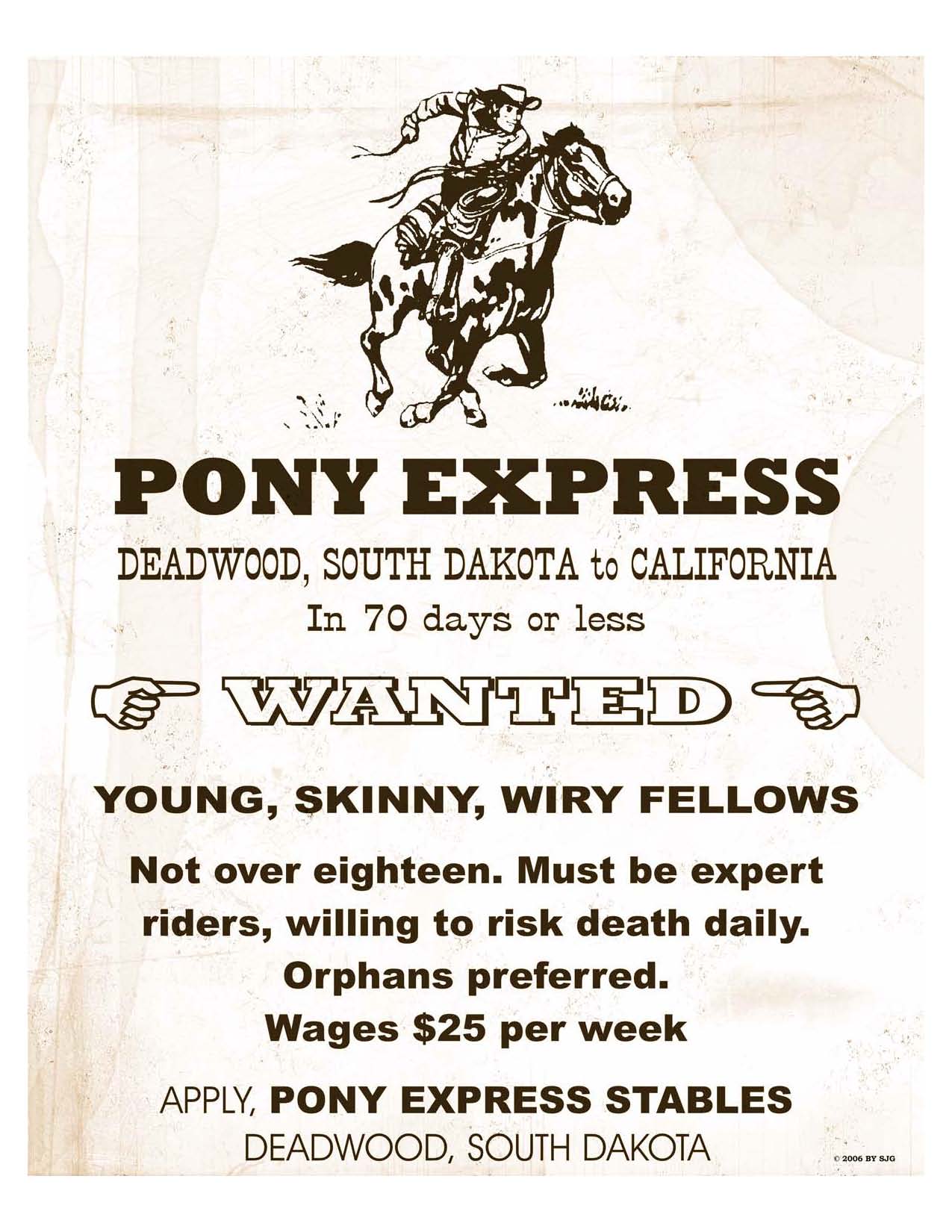
In 1860, the Pony Express was created to carry letters over a route of 1,966 miles between St. Joseph, Missouri, and Sacramento, California. The average trip took 10 days, with riders carrying only saddlebags containing mail and sidearm to fight off the Indians. A one-half ounce letter cost $5 to send by the Pony Express, and a mailbag would therefore be worth $3,200 in postal fees. At relay stations located every 25 miles, the rider picked up a fresh horse.

The Pony Express horses were mostly tough Mustangs, some with a "dash" of Thoroughbred or Morgan in their blood. After only two years, the Pony Express was replaced by the telegraph and the railroad. In spite of its brief existence, the Pony Express played a flamboyant and significant role in the opening of the American West.

The horse plowed his fields, pulled his wagons and carriages, and became an essential part of the rural economy. The loss of a small farmer's horse frequently meant his ruin. The horse population grew immensely during the 1800s. In 1867, the rural horse population in America was estimated at nearly 8,000,000, while the number of farm workers was well under 7,000,000. By the early 1900's, there were nearly 20,000,000 on America's farms.

This picture was recently discovered, not sure what the man is doing but the picture was dated in the 1870's and the picture is of a dead horse in the middle of a town road with a man sitting on the horse in formal dress. One person, Dipple, believes that the town had a law on the books that required a man to stay with his dead horse until it was removed.
Custer's Last Stand - June 25, 1876:
One of the most storied events in the history of the American West was the Battle of the Little BigHorn, otherwise known as "Custer's Last Stand."

George Armstrong Custer, whose earlier cavalry career included the interception of the General Robert E. Lee at Appomattox, was assigned as Commander of the 7th Cavalry at Fort Riley, Kansas.

When ordered to move a band of Indians toward a large American cavalry force, the ambitious and often arrogant Custer became over-zealous, and as they reached the Sioux encampment, he divided his regiment and decided to fight. Custer's force was entirely annihilated within a short time. The other regiment was rescued by supporting cavalry four days later, and the search for survivors of Custer's troops began. Not one man was found alive and only one horse survived - Comanche. After the Battle of the Little BigHorn, a horse was found in a thicket with seven arrows in his body. The horse, named Comanche, was a gelding ridden by Captain Keogh, one of Custer's officers. The horse's wounds were treated and he was carefully loaded onto a riverboat.

Comanche was sent back to Fort Lincoln in the Dakota Territory, where he was given great attention until he recovered. As an honor, Comanche was given the freedom of the fort's grounds. The Seventh Cavalry's commanding officer insisted that Comanche be saddled for all engagements and official occasions, but he could never be ridden again.

Comanche became a national celebrity. On his death, his obituary appeared in newspapers throughout the country. Comanche was taken to a taxidermist after his death and is now exhibited at the Museum of Kansas University.
The Nez Perce (1877) inhabited the mountainous plateau region at the intersection of what are now the states of Oregon, Washington, and Idaho. Here, in the region of the Palouse River, the steep mountains and box canyons provided natural enclosures in which horses could be contained or separated for selective breeding.


The Civil War (1861 - 1865)was largely a bloody slugging match of infantry and artillery, which left 600,000 men dead. The cavalry lent some of the few moments of glory to this otherwise brutal war. The South's cavalry remained superior to the Union's for the first two years of the war. The reason for this was threefold: first, in the rural South, boys grew up riding horses, whereas in the North, horses were usually driven, not ridden.


Once the cowboy emerged, his life was often lonely, with only his sturdy horse for companionship. The early ranges were not fenced, and the cattle had to be watched constantly for fear they might stampede during a thunderstorm or when threatened by a predator. Regular chores included cutting out calves for branding and in the earlier days of the range, fighting off the Indians who were protecting their hunting grounds from the white man's invasion. Horses were valued during the war and specially made gas masks were provided for the horse.

In 1908, Henry Ford invented the Model T and at that point in history, the destiny of the horse was changed forever.


In 1910, horses were used to deliver milk, horses were used in various way like to remove waste and garbage from our cities, perform taxi service, pull our fire engines, delivery ice, fight our wars, carry our dead and even today they still pull the wagon of America's Budweiser Beer.

In 1912 in Stockholm, the horse once again became a part of Olympic competition through the vigorous efforts of Count Clarence von Rosen. The Olympic classes include individual dressage, team 3-day event, and individual and team jumping classes, with each nation entering a team of six riders. Equestrian events are the only Olympic competition in which men and women compete on an equal basis. Once again, the horse is the great equalizer.

When the American Expeditionary Force entered the war, it took with it an additional 182,000 horses. Of these, 60,000 were killed and only a scant 200 were returned to the United States. In WWI over 1.5 million horses were used and over 1/3 of them died. In spite of the innovations of World War I, one reality remained the same; the horse was the innocent victim.
In just 50 years, America's horse population dropped by almost 20 million. Over 10 million horses died in World War II fighting our battles. Now the horse was no longer a necessity. Over the years, horses have become a recreational pastime. A century ago, people had horses in order to live, now people live to have horses. Man, as the ultimate predator, would have long made the horse extinct, had it not found a use for it. Early men could only travel as fast as they could run. By mounting a horse, man was suddenly one of the fastest predators on earth. Man could now carry heavy loads, hunt more efficiently and travel the lands like never before.


Barry Waldman -
Records of animal injuries weren�t kept in the early days. During the chariot race in the 1925 film Ben-Hur, up to 150 horses were killed.
Yakima Canutt, the legendary Hollywood stuntman (and occasional John Wayne double), created one dangerous procedure involving horses. His Running W device threaded a wire, anchored to the ground, through a ring on the cinch, to the fetlocks of a galloping horse. When the horse reached the end of the wire, his forelegs were yanked out beneath him. The animal fell and launched the rider forwards spectacularly�but the horse was often injured or killed.
Restrictions were put in place after dozens of horses died in 1936�s The Charge of the Light Brigade (star Errol Flynn helped raise the issue). But the last straw came when a horse was jumped off a cliff by the producers of 1939�s Jesse James. The animal drowned; the horse either broke its spine or panicked.
The Hays Code banned apparent animal cruelty in 1940.
Domestic animals were always regarded with esteem in various cultures. America's value the dog as our friend, yet in other cultures, it is a lowly creature and some see a dog as food. The cow is worshiped in India, is seen as wealth in Africa and is considered food by Americans. However, the horse, with all his beauty and strength, has always been highly regarded, in most all cultures and nearly everywhere in history.
After we used the horse to build our homes, to plow our fields, fight our battles in war, carry our wounded off the battlefields, delivered our crops to markets, built our railroads, discovered our country and served as our primary mode of transportation for years, we suddenly did not need them anymore.


Many horses that were no longer needed went to slaughter during this historical period. But, if a rancher had access to open space, he often opted to simply release the stock into the wild.

Hoses were so devalued that they were chased by helicopters, sprayed with buckshot, run down by motorized vehicles until deathly exhausted, weighed down with tires so they could be picked up by rendering trucks.

Roy Rogers purchased Trigger in 1938 for $2,500. He was out of a Thoroughbred stallion and a Quarter Horse mare. Trigger's striking gold coat with white mane and tail greatly helped to popularize the Palomino. In June1965 , Trigger died at over 30 years of age with more than 100 films to his credit.

The profound grief of Americans at the death of President John F. Kennedy was accentuated by the sight of Black Jack, the riderless horse with boots reversed in the stirrups, a symbol of a fallen hero. Black Jack was the last horse issued to the Army by the Quartermaster, and he was the last to carry the "U.S." brand common to all army horses.

Up until the 1970's, wild horses were frequently slaughtered for pet food. The capture and slaughter processes were particularly cruel, and numbers were decreasing toward a second extinction.
In 1971, Congress introduced and passed The Wild Free-Roaming Horses and Burros Act. President Richard M. Nixon signed the new Act into law (Public Law 92-195) on December 15, 1971. The Wild Free-Roaming Horses and Burros Act required the protection, management and control of wild free-roaming horses and burros.


Horse owners that call themselves horsemen can be crude and mean and still be considered great riders or great trainers. When rough and coercive methods are used to control and train a horse, you don't get the true horse and performance and trust is inhibited.

The term "Horse Whisperer" came from a time in the west when snake doctors and snake oil was being sold in most towns.


Horses still visit the White House as seen in this photo of two horses delivering the Christmas Tree to the White House in 2005. Still serving this country in honorable fashion.
The final legacy of the horse is an increasing equine population of pure and distinct breeds; horses of quality and beauty, horses for sport, work, and pleasure. Today there are hundreds of breeds and types of horses. According to the American Horse Council, in 2001 there were approximately 6.1 million horses and 7.1 million people involved in the horse industry in the U.S.
The same survey indicated that the horse industry directly produces goods and services of $25.3 billion and has a total impact of over $112 billion on the U.S. gross domestic product. The industry's contribution to the U.S. GDP is greater than the motion picture, railroad and furniture and fixtures manufacturing industries. It is only slightly smaller than the apparel and other textile products manufacturing industry. The industry pays a total of $1.9 billion in taxes to federal, state and local governments. Like when our country began and as it continues today, the horse continues to carry America.

Even today, people who are not horse owners and may know nothing about a horse, the history of a horse is still with them in many ways. Some old sayings and metaphors that are still used today were given to us by the horse. Some of these are; Someone needs to pull the reins in, refers to someone who is out of control; Horsepower is still the standardized measurement for engine power; No horseplay signs are still used at many public pools sites since horses love to play; Colt firearms is one of the best gun makers around; When asking for someone's name and information it is acceptable to ask for your horsepower; Some refer to meeting for a drink as "Meeting at a watering hole" since it is common to see horses gather at a drinking spot;


Are horses better off now that people don't need them and only those that own horses want them? Only history will answer this, but a few things have not changed. Man is still the ultimate predator and will always put all other animals below him. And the horse is still the faithful companion which has carried America and mankind on his back since the beginning of time, never asking for anything in return.
